Docs / Introduction Learn
The EKOS Approach
Treat knowledge recovery like compilation: observe, analyze deterministically, resolve identities, store with evidence, serve read-only.
EKOS borrows its structure from programming-language compilers, because the problem has the same shape: lots of messy input, a need for a reliable intermediate form, and an output that must be trustworthy.
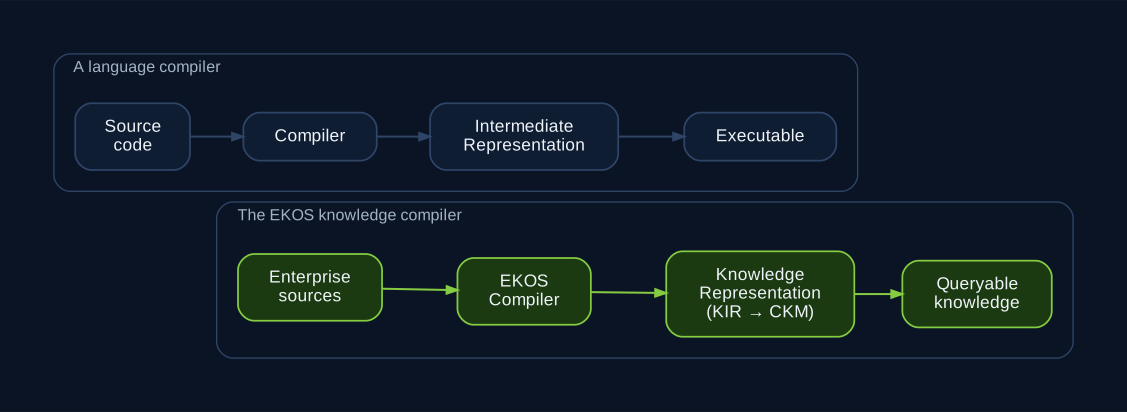
Five principles
- Observe without interpreting. Connectors collect facts (file contents, schema DDL, commits) and hash them into content-addressable artifacts. They never decide what things mean.
- Compile deterministically. Analysis passes are pure and side-effect-free: same input, same output. Where an LLM is used, it is labelled as such and its output is stored as a reviewable claim, not as fact.
- Keep the evidence. Every conclusion links to an evidence record — a source location plus the fragment it came from.
- Append, never rewrite. The ledger only grows. Changes are new entries, so history is reconstructable and audit is free.
- Serve read-only. Agents get the knowledge through a read-only runtime (MCP). They never touch your raw systems.
Discover → Compile → Preserve → Query → Act
| Stage | What happens | Command |
|---|---|---|
| Discover | Connectors observe sources | ekos build |
| Compile | Analyzers recover structure; identities resolve; the Canonical Knowledge Model is built | ekos recover, resolve, compile |
| Preserve | The model is committed to the append-only ledger | ekos commit |
| Query | Humans and agents ask through the CLI or MCP | ekos ask, ekos query, ekos mcp serve |
| Act | The agent uses grounded answers to change code, plan migrations, assess impact | your agent |