Your systems already describe themselves — in source code, SQL, ETL jobs, Git history and docs. EKOS reads all of it, compiles it into one evidence-backed knowledge ledger, and lets AI agents query that ledger over MCP. Every answer points back to the exact file and line it came from. Open source, written in Rust, built in public.
Compile your systems once. Query them with proof.
Enterprise knowledge isn't missing — it's scattered across code, schemas, pipelines, infrastructure and years of commits. Search tools and vector indexes guess at it on every query. EKOS takes a compiler's approach instead: it observes each source without interpreting it, runs deterministic passes to build a single Canonical Knowledge Model, and records the result in a versioned, append-only ledger. AI agents read that ledger over MCP, and every fact they get back carries its provenance.
The problem was never a lack of information. It was the lack of a compiler that turns how your systems actually work into knowledge you can trust. EKOS is that compiler.
Read the systems, don't guess
Application code, SQL, legacy ETL, Git history and documentation come in as raw, content-addressed evidence. Nothing is summarized or rewritten on the way in.
One model for everything
Deterministic passes turn every source into Objects, Relationships, Events and Evidence, and commit them to an append-only ledger you can replay and audit.
Answers that cite their source
Agents in VS Code, the CLI or the web console query the ledger read-only over MCP. Each answer links to the fragment it was built from, so it can be checked.
It started as one repository. It's growing into a platform.
EKOS grows in stages, the way the creature below grows from a single cell into a galactic civilization. Each stage maps to a phase of the engineering roadmap: an open-source core and its community first, then a shared knowledge network, a plugin marketplace, an enterprise platform, an agent marketplace and, eventually, an open knowledge economy.
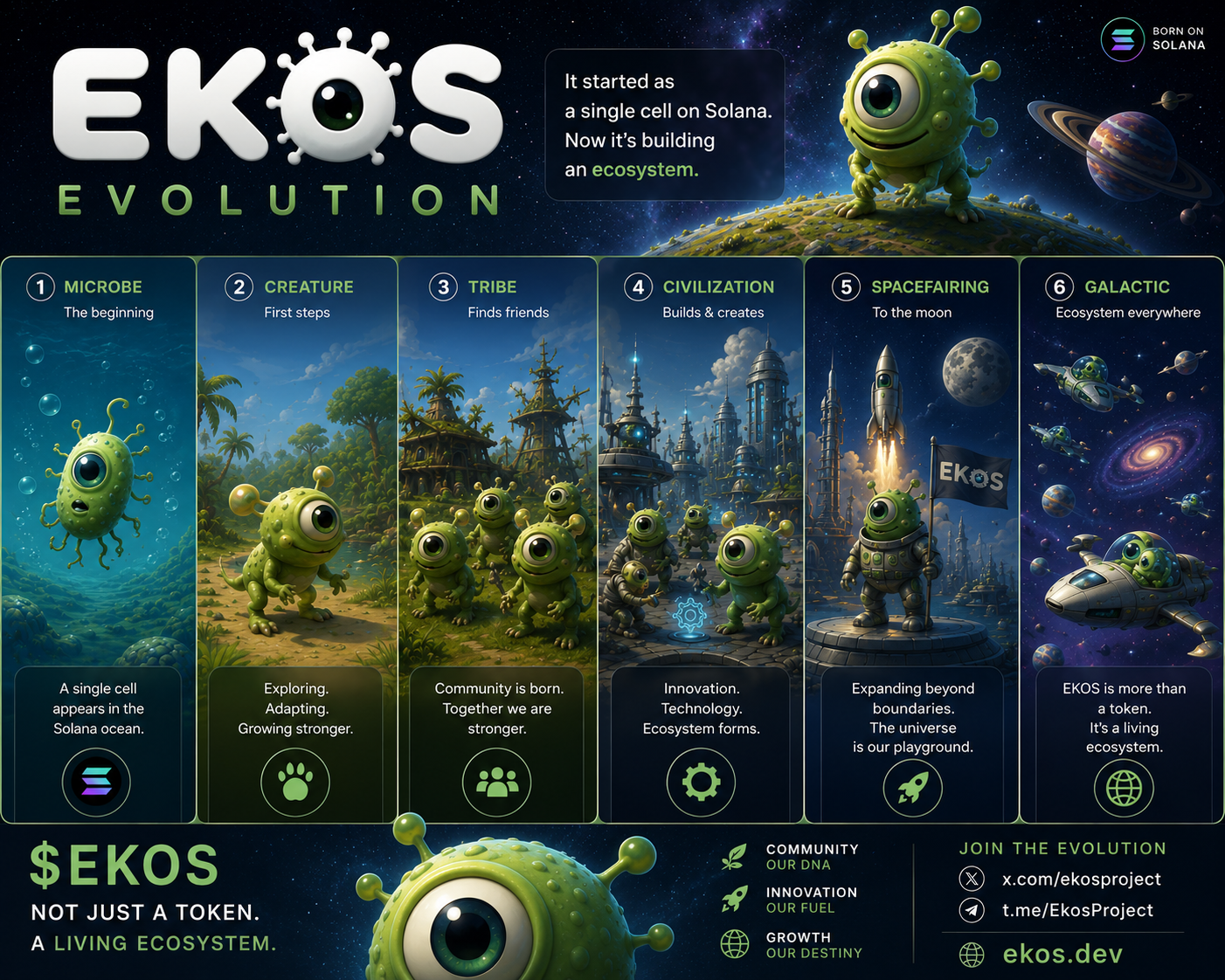
Where EKOS is today, and where it's going.
Phase 1 is here: v1.0 of the compiler with its CLI pipeline, MCP server, VS Code integration and web console, with the core Rust crates being published to crates.io. Everything after that is planned, not shipped — each phase is designed in public RFCs before any of it is built.
Open-Source Core
The compiler, CLI, MCP tools, web console, docs and public RFCs. Anyone can run it, read it and contribute.
Knowledge Network
Broader source coverage — more SQL dialects, Pentaho, dbt, new parsers and connectors — backed by grants and bounties.
Plugin Marketplace
Publish a parser, connector or knowledge pack, and get rewarded when others use it.
Enterprise AI Platform
Companies connect their systems and get one evidence-backed graph their AI agents can query.
Agent Marketplace
Purpose-built agents for migration, optimization and lineage, running on top of the ledger.
Knowledge Market & Governance
Licensed knowledge packs, community governance and reputation-based maintainership.
The people building EKOS.
A small core team with backgrounds in data engineering, software development, AI research and ecosystem growth, working entirely in the open.

Alexey is a data engineer and solution architect who has spent his career designing data platforms, analytics solutions and distributed systems. He started EKOS to solve a problem he kept running into: large data estates that nobody can fully explain, trace or safely change.
He leads EKOS's architecture and engineering, bringing together data engineering, compiler-style design and AI tooling into something data teams can use every day.

Omid researches sustainable AI for the oil, gas and petrochemical industries, focusing on intelligent agents, autonomous systems and reliable AI infrastructure for industrial environments.
The token supports the project. It isn't the project.
EKOS is open knowledge infrastructure for enterprise AI. The $EKOS token on Solana is there to reward and coordinate the people who help build it — contributors, bounty hunters and community members. Any utility it gains is meant to follow real adoption of the platform; it is not a promise of price. Full details, including live vesting figures, are in the repository.
| Holder | Quantity | % Supply | Status |
|---|---|---|---|
| Public / market holders | ~937,260,000 | ~96.9% | Circulating |
| Founder — Vesting | 14,000,000 | ~1.45% | Locked |
| Community Rewards | 5,000,000 | ~0.52% | Circulating |
| Founder Lock | 4,000,000 | ~0.41% | Locked |
| Bounty Fund | 3,600,000 | ~0.37% | Circulating |
| Founder — Personal Wallet | 3,550,000 | ~0.37% | Circulating |
| Treasury | 0 | — | — |
32,590,000 EKOS have been burned, reducing total supply from 1,000,000,000 to 967,410,000. 18,000,000 EKOS are time-locked (Founder Vesting + Founder Lock), leaving ~949,410,000 (~98.1%) in circulation. Every row is part of the 967.41M total. Founder custody of ~30,150,000 EKOS (~3.1%) is shown for transparency and is not reserved supply: the Bounty Fund and Community Rewards are earmarked for the community, and the personal wallet is mostly open-market buys. The former Treasury (2M) and 1.6M from the founder wallet were moved into the Bounty Fund for the "Make EKOS More Visible" activity. · Full tokenomics → · View on Pump.fun →
CwubepDFJndzSKFmAMAm9u8Xx3PrizAwSq8hcGimpump
Run it on your own systems.
Point EKOS at a repository, compile it, and ask your agent what breaks if a table changes. 113 RFCs, 127 devlogs and real benchmarks — all public, nothing behind a gate.