Turn your code, databases and docs into a knowledge graph your AI agent can query
An AI agent spends most of its tokens rediscovering your system in every session. EKOS does that work once: it reads source code, SQL, ETL jobs, database catalogs, Git history and docs, and compiles them into one graph that agents query over MCP. Every fact comes with the file and line it was read from. No model call is needed to compile. It runs on your machine. Open source, written in Rust.

curl -fsSL https://raw.githubusercontent.com/alexeyban/EKOS/main/install.sh | shpowershell -ExecutionPolicy Bypass -c "irm https://raw.githubusercontent.com/alexeyban/EKOS/main/install.ps1 | iex"Opens EKOS Setup: where EKOS goes, the web console, a first
project, your AI agents, a chat model. Prefer a native installer? .msi, .pkg,
.deb and .rpm, with the EKOS.DEV desktop app, are on the
releases page ·
Installation guide
A semantic model your agent can check its SQL against
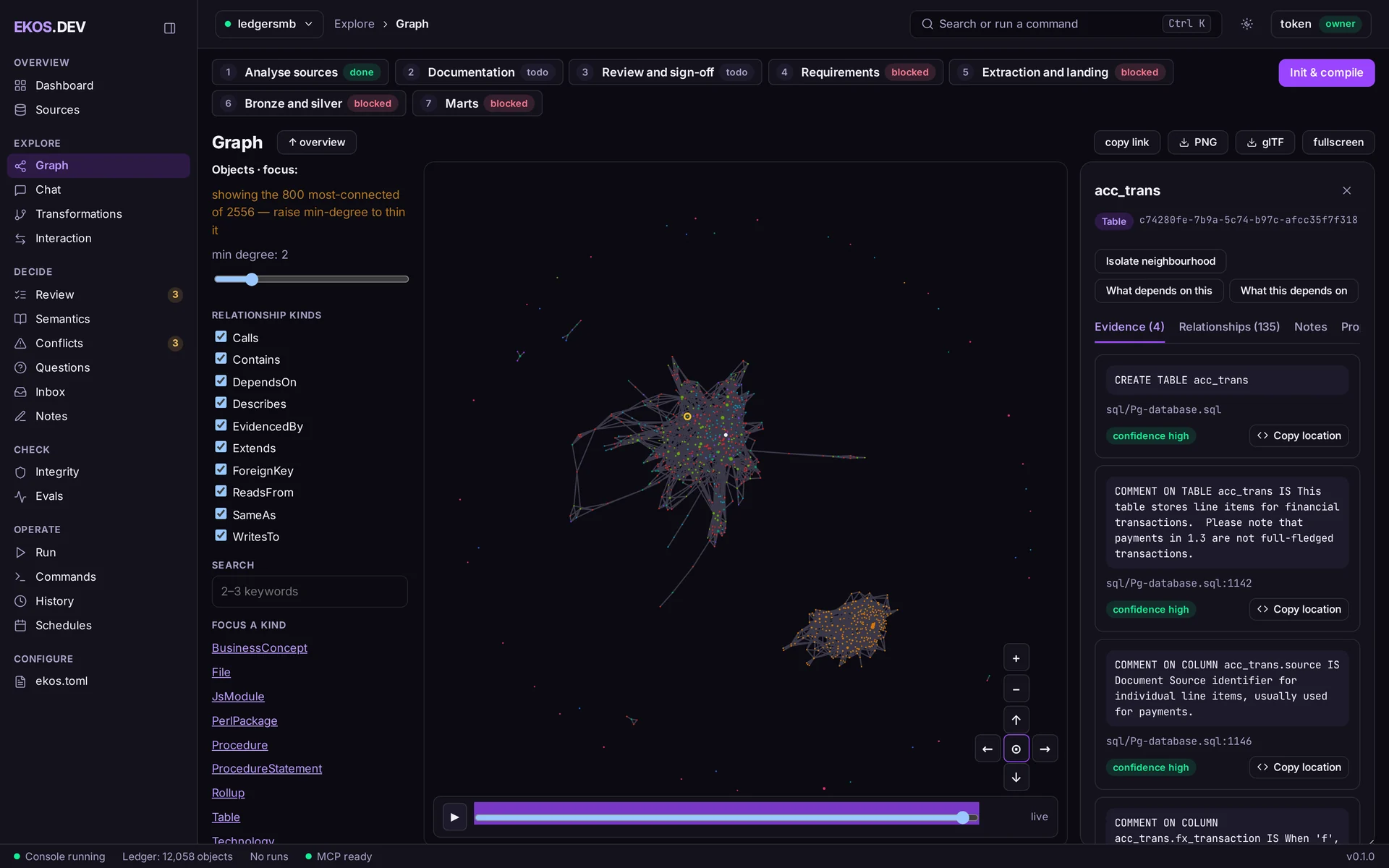
EKOS compiles schemas, stored procedures, ETL jobs and documents into one model: what each table and code value means, how tables join, and where every fact was read. A meaning stays a hypothesis until a person confirms it.
Compile your systems once. Query them with proof.
What a system does is already written down, in its code, schemas, pipelines and years of commits. Search tools and vector indexes guess at it again on every question. EKOS reads each source once, builds one model of the tables, functions, jobs and documents and the links between them, and keeps the evidence for every link. Where two sources disagree, it reports the conflict and does not pick a side.
Ask your agent: “What breaks if I change the orders table?” · “Which job writes this table?” · “Do the docs still match the code?”
Read the systems, don't guess
Application code, SQL, legacy ETL, live Oracle, PostgreSQL, ClickHouse, SQL Server and Informix catalogs, Git history and documentation come in as raw, content-addressed evidence. Nothing is summarized or rewritten on the way in.
One model for everything
Parsers and deterministic passes build one graph from every source. The same input always gives the same result, and the append-only ledger keeps every earlier state.
Answers that cite their source
Agents in VS Code, the CLI or the web console query the ledger read-only over MCP. Each answer links to the fragment it was built from, so it can be checked.
End-to-end demos, recorded from real runs.
Each video follows one real run from start to finish, with nothing staged: every screen is from that run.

EKOS on iDempiere: from a legacy Oracle ERP to reconciled gold marts — one real run, end to end
A 903-table Oracle ERP analysed with zero model calls, reviewed and signed off by a person, then loaded through bronze and silver into three gold marts, each reconciled against silver.

EKOS Lakehouse: PostgreSQL to Apache Iceberg, generated and verified (full end-to-end demo)
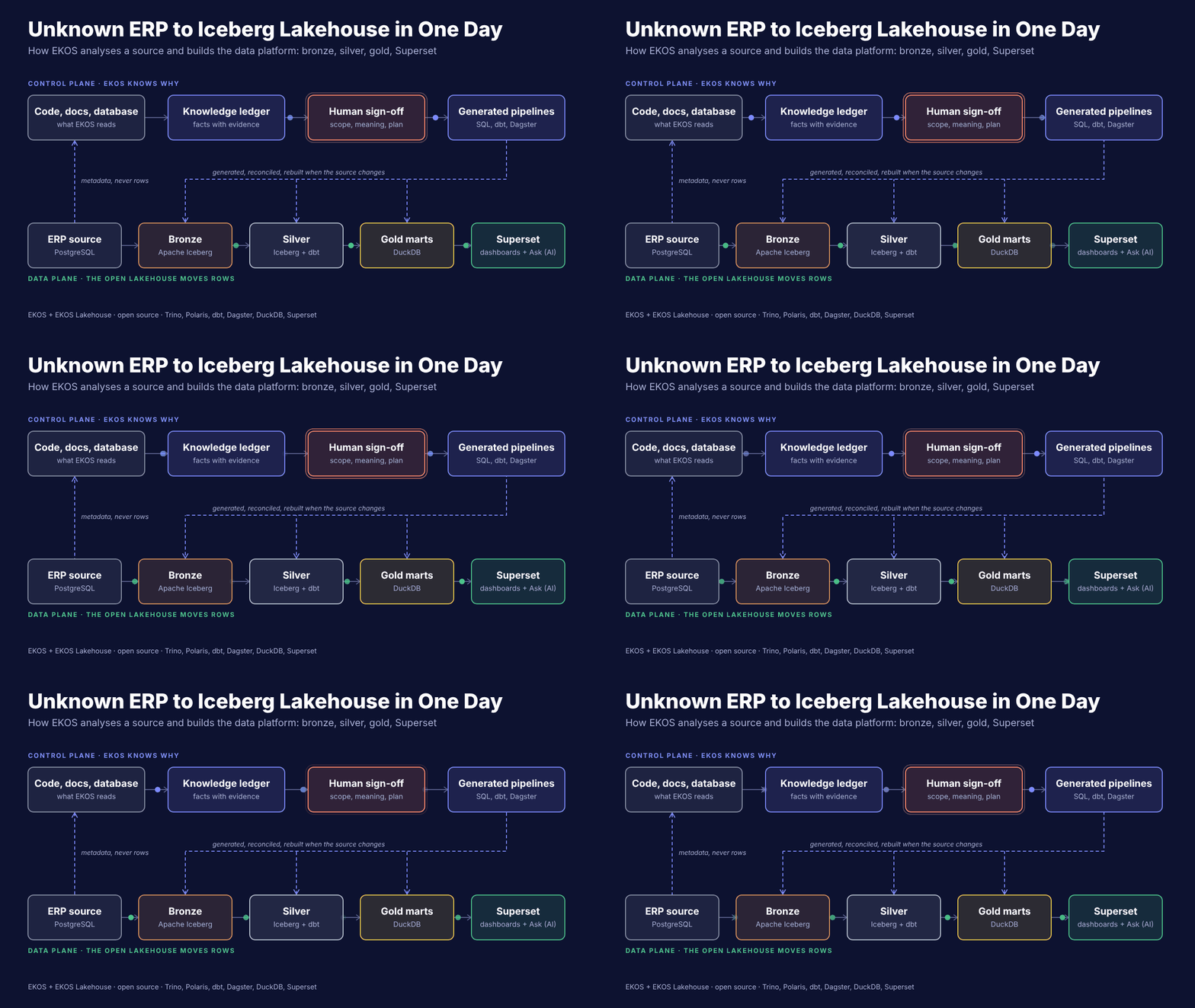
A PostgreSQL database turned into an Iceberg lakehouse: the pipeline generated from compiled knowledge, run through Dagster and dbt, and every layer reconciled against the source.
From Legacy ERP Source to a Reconciled Lakehouse
Three Questions Every Enterprise AI Team Should Ask, Answered from the EKOS Codebase
I Stopped Treating Documentation as Writing and Started Treating It as Compilation
Where EKOS is today, and where it's going.
Phase 1 is here: the compiler with its CLI pipeline, MCP server, VS Code integration and web console (latest release v1.6.1). Since November: native installers for Windows, macOS and Linux with EKOS.DEV, a desktop app for the console; live Oracle, PostgreSQL, ClickHouse, SQL Server and Informix catalogs; a seven-step workflow in which a person signs the source model off before anything is built on it; SQL written and checked against the compiled knowledge; profiles and references found in the data; a map of who reads and writes each table; people as a source; Apache Ossie export; and Terraform deployments to Azure, Google Cloud and AWS. Everything after Phase 1 is planned, not shipped — each phase is designed in public RFCs before any of it is built.
Open-Source Core
The compiler, CLI, MCP tools, web console with reviewed sign-off, docs and public RFCs. Anyone can run it, read it and contribute.
Knowledge Network
Broader source coverage — more languages, SQL dialects, parsers and connectors — backed by grants and bounties.
Plugin Marketplace
Publish a parser, connector or knowledge pack, and get rewarded when others use it.
Enterprise AI Platform
Companies connect their systems and get one evidence-backed graph their AI agents can query.
Agent Marketplace
Purpose-built agents for migration, optimization and lineage, running on top of the ledger.
Knowledge Market & Governance
Licensed knowledge packs, community governance and reputation-based maintainership.
The people building EKOS.
A small core team with backgrounds in data engineering, software development, AI research and ecosystem growth, working entirely in the open.

Founder and original creator of EKOS, responsible for its vision, core architecture and technological direction.
Alexey conceived and built EKOS to address a fundamental challenge in modern enterprise engineering: transforming complex, fragmented technical environments into structured, traceable knowledge that AI agents can reliably understand and act upon.
He defines the project's long-term vision and leads its architectural evolution, combining deep expertise in enterprise data platforms, distributed systems, compiler design and AI-native engineering.
As the principal architect behind EKOS, he drives the development of its core technology and shapes the foundation of an emerging ecosystem for AI-driven software engineering.

CEO and co-founder of EKOS, leading strategic growth, partnerships and business development.
Technical expertise: AI infrastructure, autonomous agents, x402 agentic payments, and AI-driven development of refinery fluid systems and equipment.
Run it on your own systems.
Point EKOS at a repository, compile it, and ask your agent what breaks if a table changes. 232 RFCs, 317 devlogs and real benchmarks — all public, nothing behind a gate.